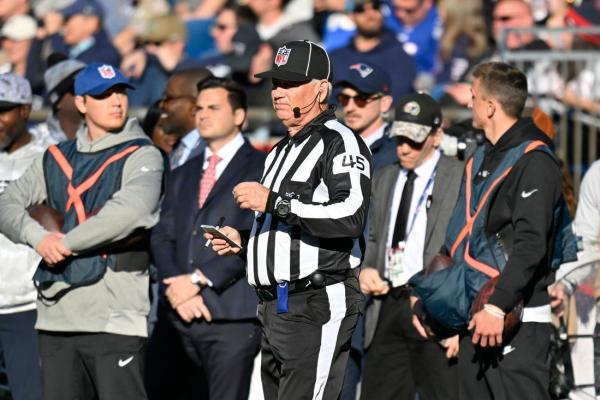
The NFL Referees Association is challenging the severity of the suspensions given to two officials Monday for unprofessional conduct.
The union released a statement Tuesday saying the league’s suspensions of line judge Jeff Seeman for two games and referee Adrian Hill for one game were “excessive and inconsistent with past precedent.”
The NFLRA said it plans to meet with the NFL’s officiating department to discuss disciplinary standards. It also plans to address player conduct.
NFL vice president of officiating Ramon George issued the suspensions Monday. Seeman made headlines Sunday when he was caught on video saying “f– you” twice to Arizona tight end Trey McBride while he worked the Cardinals’ game at the New York Giants. McBride was complaining about the lack of a pass interference call late in the game, and the video caught the attention of NFL Players Association executive director JC Tretter.
“This kind of behavior from an official towards a player is unacceptable,” Tretter wrote on social media. “Players are consistently held accountable when the roles are reversed. We expect the NFL to hold officials to the same standard.”
Hill was officiating the Minnesota Vikings’ home game against the Miami Dolphins when, on a play that was whistled dead for a penalty, Dolphins running back Ollie Gordon II blocked Vikings linebacker Eric Wilson into Hill, knocking him down.
Hill reacted angrily and was seen yelling at Wilson to go back to his team’s huddle, though Wilson told reporters later that the situation was “funny” and Hill was “cool about it” after Wilson apologized.
Public reprimands and suspensions of NFL referees are rare, with the website Football Zebras noting that the last time an official was placed on leave was umpire Roy Ellison in 2018.
Still, NFLRA executive director Scott Green maintained that “verbal abuse from players and coaches” as an extenuating factor should not be glossed over.
“We will defend the principle that discipline must be fair, consistent and proportionate. Holding officials accountable while ignoring or minimizing the conduct directed at them is neither fair nor an effective way to address this issue. We look forward to working with the League and NFLPA toward that shared goal.”