Players who started their first round at the U.S. Open in the afternoon wave may not know what the morning crowd was griping about.
Rory McIlroy stepped off the course at Shinnecock Hills Golf Club proud to have posted a 1-under-par 69, one off the lead at the time. “I think with the conditions today, anything under par or anything around even par is a good score,” the Northern Irishman said.
Yet when play was suspended due to darkness Thursday in Southampton, N.Y. Wyndham Clark held a four-shot lead on the pack at 6 under par. He saved par from a greenside bunker at the par-3 seventh, his third-to-last hole, before heading inside.
Play was suspended early Thursday morning due to persistent fog, delaying the round for two hours. But there would be no stoppage of play due to wind gusts off Long Island’s Peconic Bay. Whipping wind is what ratchets up the difficulty of this course, and the USGA laid its plans around that fact entering the week.
Without much wind in the later hours, however, the USGA’s setup was softer than the U.S. Open’s reputation calls for after winds howled for those in the morning wave.
“I would say when I got my tee times on Tuesday, I was like, ‘Oh, could be a tough draw,'” Clark said. “That two-hour fog delay was very helpful, and it was really nice (that the wind) laid down. So it definitely helped those last six, seven holes we played.”
Per the USGA and Elias Sports Bureau, the scoring average for players with morning tee times was 73.87 at the par-70 course. The late wave’s collective average at one point stood nearly a full stroke lower — 72.88 — and was expected to remain in that ballpark before play was halted.
McIlroy and his peers understood the governing body’s moves for the first round, which included softer-than-usual greens and a few easier pin locations.
“The greens are pretty slow and quite receptive,” McIlroy said. “I think they need to be at this point. It’s a challenging golf course already, and you put 30-mile-an-hour winds on top of it, it tests the best players in the world pretty well.
“Yeah, I think they were prudent with the course setup, and they made sure to — I think especially with starting with 156 (players) the first two days, you just want to get everyone around without too much issue.”
Keegan Bradley added, “The USGA did a great job setting the course up because, if the greens were any faster or firmer, we might not be playing right now.”
McIlroy was eager to relay that when he eagled the par-5 fifth hole, he had 194 yards to the pin for his second shot and had to club down to a mere pitching wedge.
“I was trying to pitch the ball like 180, and I ended up pitching the ball like 190,” he said. “I carried that pitching wedge 190 yards. It just shows how strong the wind is out there.”
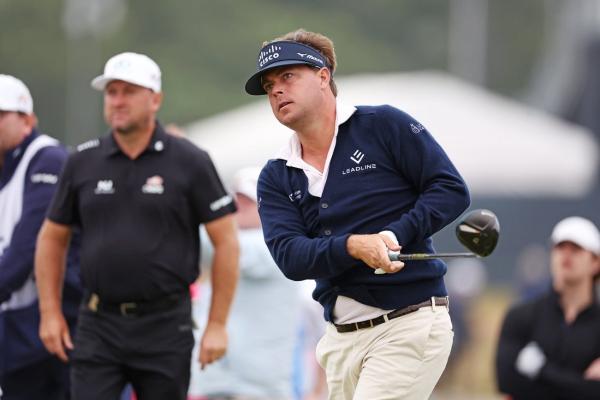
Keith Mitchell, who posted an even-par 70 along with Bradley, was an example of someone who got a taste of Shinnecock Hills before and after the winds died down.
After his tee time was delayed to around 11:20 a.m., Mitchell started his day on the back nine, opened with a double bogey and went out in 6-over-par 41. But in the afternoon he turned it around and posted a 6-under 29 on Shinnecock’s front nine, featuring an eagle at the par-5 fifth hole after his approach shot settled softly to 13 feet.
That second-nine surge brought him to an even-par 70 he won’t soon forget.
“If you hit the fairway, you had a chance. I didn’t do that very often on the back nine,” Mitchell said. “… The greens are so effectively small, like, if you hit the target, you’re going to have a 15- to 20-footer. Fortunately, I just hit some really, really good shots on the back nine.”